

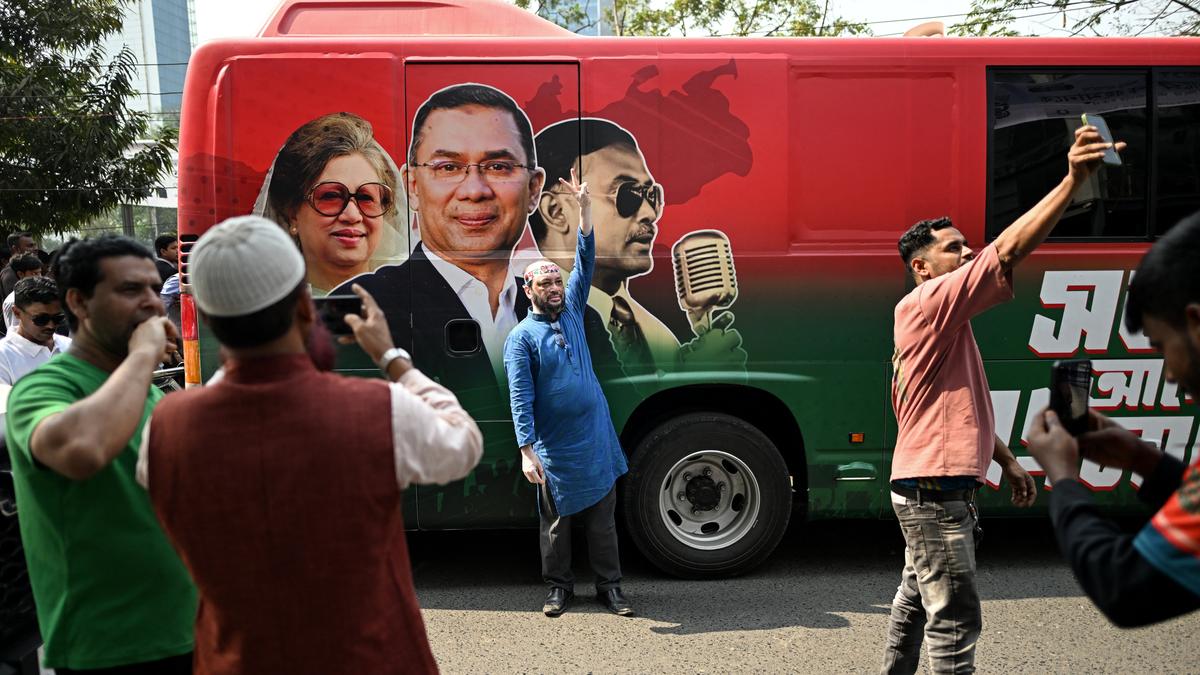
On February 12, in Mogbazar, a densely populated area in Dhaka, hundreds of Jamaat-e-Islami cadres gathered together. Wearing colourful caps and fine Oud, they watched the future of Bangladesh’s politics being rewritten. While the Bangladesh Nationalist Party (BNP) won the election, securing 209 seats out of 300, the Jamaat-e-Islami, the principal challenger, won 68, its highest tally since the country’s independence.
Also read: Bangladesh election results highlights
The polls were necessitated by a student-led uprising that ousted Prime Minister Sheikh Hasina in August 2024, after which an interim government took charge to oversee the transition to a newly elected administration. Hasina’s Awami League was banned from the elections, marking a historic first since 1971, the year Bangladesh was formed.
Outside the narrow alley, fruit, vegetable, and fish sellers struggled to cope with the sudden surge of outsiders. After all, it was not every day that so many people showed up at the Jamaat-e-Islami’s headquarters.
The party’s multistorey headquarters is hidden behind a large iron gate. Inside, visitors are greeted by a row of taps used for the ceremonial wazu, the ritual washing mandatory in mosques. The party cadres are expected to not only engage in politics, but also to strictly observe their religious duties. Between celebrations, they join prayers. Afterwards, they gather for a quick lunch of kachchi biryani accompanied by burhani, a soothing yoghurt-based drink with coriander and mint. The mood is unmistakably festive.
At home
There was a time when the headquarters was largely quiet with dedicated cadre in white salwar kurta carrying bundles of pamphlets and books and going about their work. In 2024, the Hasina-led Awami League banned the organisation. Now, sharply tailored business suits have entered the Jamaat, resurrected in 2025.
For nearly one and a half decades, Mohammed Fakhrul Islam, a barrister working for the party in the U.K., says he stayed out of Bangladesh, as Sheikh Hasina and her Awami League governed Bangladesh. During this period, Jamaat-e-Islami built its political narrative around the themes of discrimination, torture, and exile. Islam says he did not return, as coming home would have meant harassment or worse, detention under some law as the party faced continuous pressures from the regime.
According to Islam, the Jamaat-e-Islami wants Bangladesh to be “self-sufficient and strong”. He says the party expects India to “acknowledge the mistakes that it had committed by oversubscribing to the politics that Hasina represented”.
Islam and his friends are not just Islamists; they also project themselves as survivors of an oppressive regime. Oliullah Noman, Islam’s colleague, who was part of the election steering committee, says, “I was allowed to leave (the country) after I served a prison term. They tortured me in prison.”

Supporters of Bangladesh Jamaat-e-Islami at an election campaign rally in Dhaka. | Photo Credit: Reuters
Noman works as a senior editor with Amar Desh, a newspaper launched in September 2024 after Hasina’s fall. The newspaper is edited by Mahmudur Rahman, who, like Noman, was also in exile for several years. Rahman returned from Istanbul after five and a half years, and it was during his public reception that Sharif Osman Hadi, the Islamist student leader, first came to be noticed for his organisational abilities.
Hadi, who was killed in December 2025 in Dhaka when he was just 32, shared with Oliullah a strong opposition to Hasina, though for both, the recent history of persecution carries more weight than the events of the Liberation War.
Oliullah and Islam believe that both the Liberation War of 1971 and the uprising of 2024 were similar in essence. “Why did the Liberation War take place? It took place because of discrimination against Bangladeshis by the Pakistan government. Similarly, it was discrimination by the Sheikh Hasina government that prompted us to fight in 2024,” says Islam.
On being asked why Jamaat-e-Islami and Al-Badr were involved in the 1971 violence, he says, “We did not oppose Bangladesh’s freedom. We opposed the partition of our country. After all, who would want to see their nation divided?”
Growing disappointment
That strand of unresolved history stretches from Mogbazar to Dhanmondi, about 5 kilometres apart. Along the main road of Dhanmondi’s business district stands a mango tree planted in 1969 by Tajuddin Ahmed, the first Prime Minister of the Mujibnagar government — the government-in-exile formed by Awami League leaders in 1971. Ahmed, who became Bangladesh’s first finance minister after 1971, was one of four national leaders killed by the military on November 3, 1975. This occurred just months after Sheikh Mujibur Rahman was assassinated on August 15.
For more than five decades, the tree has been witness to the storms that have blown through Bangladesh. The site beside the mango tree, once the residence of Ahmed, known for his intelligence and organisational skills, is no longer a home. Today, it has been replaced by a multistorey shopping complex. The only reminder of Ahmed is a large poster of Sohail, his fitness-enthusiast son, who runs a gym at this address.
“If necessary, we will fight another war. War is inevitable,” says Md. Nahid Akhtar Nahan, a supporter of the Awami League, banned under Bangladesh’s Anti-terrorism Act.
Nahan was a councillor of the Awami League in Rajshahi and saw the peak of the power and authority of the Hasina era. But he also noticed the warning signs early on. “She became absolutely intolerant of frank opinions. On multiple occasions, we saw how Hasina apa used to flare up on hearing opinions that were anti-establishment. Her top ministers were promoting the business interests of individuals directly linked to Jamaat-e-Islami,” says Nahan, who has lost his house and property to mob attacks.
He has no job and fixed income, and depends on friends and well wishers. “The Awami League is an emotion for us. We believe in the spirit of 1971 and the memory of Sheikh Mujib,” he says.
Nahan emphasises that Bangladesh is now a battleground between two opposing forces — one that upholds the spirit of 1971 and the other that stands against it. He laments how Dhaka has changed. “Earlier, people would mark the Bhasha Andolan (mother tongue movement) of 1952,” he says. This was when the police shot several activists — including Abdus Salam, Rafiq Uddin Ahmed, Abul Barkat, and Abdul Jabbar — who demanded that Bengali be recognised as the national language of Pakistan.
“Every year, a massive book fair would open on February 1, culminating in a major road show on February 21. But no more,” Nahan says. “It is as if our emotions are no longer important. The war of 1971 was borne out of such actions and we will fight again if necessary.”
Pointing at the image of Sohail with his bulging biceps, Nahan says the Awami League does not forgive betrayal. In the eyes of Nahan and his friends, Sohail did something that an Awami League member was not supposed to do. “He met with the Chief Adviser, Mohammed Yunus. He was hoping to get something in return. But he did not,” he says.
Anger only grew when Hasina’s son, Sajeeb Wazed Joy, gave an interview to a western news outlet. In it, he said, “I have spent all my life abroad. I have been in the U.S. for 30 years. I am living peacefully here. Whatever will happen in the future is something for the future.”
A supporter of the party says the party cadre were livid and dismayed. He says, “We called each other and wept on the phone hearing how Joy spoke about the party of Sheikh Mujib.”
A tough choice
In such an atmosphere, the return of Tarique Rahman, 60, the chairman of the BNP, from exile in London, has drawn appreciation from forces who are willing to join hands with any side for the sake of stopping the Jamaat-e-Islami’s march. The BNP, which won a landslide victory in an election that saw a voter turnout of 59.44%, has returned to power after nearly two decades.
Zakir H. Chowdhury, the head of the BNP’s youth chapter, says many Awami League supporters voted for the BNP. He explains the electoral politics by pointing to the alliance between the Jamaat-e-Islami and the student-led National Citizen Party. “Some Awami League voters first considered voting for the Jamaat. They believed that a strong Jamaat would jeopardise internal security, prompting people to demand the return of the Awami League as their saviour. But they changed their minds on seeing its alliance with the leaders of the 2024 uprising — they really hate them,” he says.
Barek Kaiser, a media commentator, says it was a tough choice for Awami League supporters “They voted for the BNP. It was like having a heavy boulder on their chest. It was not easy for them to support their main opponent.”
A short-lived spring?
The Jamaat-e-Islami chief, Ameer Shafiqur Rahman, increased media engagement ahead of the 2026 elections. His aim was to rebrand the party from a rigid Islamist group to a more moderate, mainstream political entity. But the outreach has not been enough to ease the growing anxiety in Dhaka about what the Jamaat may be planning in the months ahead.
The party’s highest tally before this election came in 1991, when it won 18 seats in the polls held after the overthrow of President Hossein Mohammed Ershad, which brought Khaleda Zia of the BNP to power for the first time. Zia died last December. Rahman is Zia’s son.
The Jamaat-e-Islami’s influence and parliamentary presence dwindled thereafter. Its worst phase began after 2009, when an Awami League government, strengthened by a sweeping electoral victory, set up the International Crimes Tribunal to try several Jamaat leaders for their alleged complicity in the 1971 killings. As a result, several senior figures were executed.
Along with the euphoria of the BNP’s victory, suspicion and fear now run deep in Dhaka. A former student leader from Chittagong University says, “Only those who have studied at Chittagong and Rajshahi University know what the Jamaat’s student wing is capable of. If they dream of imposing Shariah in Bangladesh, they will do it whenever they find the opportunity.”
At the moment, however, the Jamaat is far from introducing Shariah law in Bangladesh. Its immediate goal is to focus on the transition of power from the interim government to the BNP-led one. It has already voiced its grievances, viewing the victory of the BNP as a warning sign.
Ameer Shafiqur Rahman says his party is disappointed by the outcome. He blames authorities for being biased against his party. “We are not satisfied with the process surrounding the election results,” he said after the party-led Islamist bloc got an unprecedented 77 seats. “From candidates of the 11-party alliance narrowly and suspiciously losing in various constituencies, to repeated inconsistencies and fabrications in unofficial result announcements, the Election Commission’s reluctance to publish voter turnout percentages, and indications that a section of the administration leaned towards a major party... all this undoubtedly raises serious questions about the integrity of the results process.”
Along with the national election, voters were asked to decide on an ambitious and wide-ranging constitutional reform package under the July National Charter (Constitutional Amendment) Implementation Order, 2025. The citizens voted ‘yes’ in favour of it. The proposed changes in the referendum include establishing a neutral interim government for the electoral period, restructuring the current parliament into a bicameral legislature, increasing women’s representation, strengthening judicial independence, and introducing a two-term limit for the Prime Minister.
“Parliament is the supreme organ and laws are made by Parliament. The referendum wants changes in the parliamentary system. Nothing like that will be allowed (by Parliament members),” says Chowdhury of the BNP.
On the other hand, Jamaat has made it clear that it wants the proposed referendum to incorporate the July Charter into the 1972 Constitution of Bangladesh.
With the BNP planning to make its position clear, the Jamaat seeking to assert its parliamentary strength and secure a greater role in national politics and India-Bangladesh relations, and Awami League cadres mobilising for a potential confrontation, Dhaka looks less like the site of a concluded electoral contest and more like the staging ground for another political showdown.
“We are in a war zone,” Kaiser says. “We just had an election. But we might soon end up with a real conflict.”
Published - February 14, 2026 02:14 am IST

