

February 16 began like any other Monday: busy and chaotic, and it was particularly so in the modest home of 31-year-old lorry driver Lova Raju and his 28-year-old wife D. Kirthi at Danavayipeta in Rajamahendravaram city. Notwithstanding their financial woes, the young couple had something to look forward to — Kirthi was in the final weeks of her second trimester and, in a few months, they would welcome their second child.
Just like the previous day and every day prior, Kirthi gently woke their 21-month-old son Rithik, who was still curled up under the sheets. After the morning routine, he was fed a cup of warm milk, purchased from a local vendor only hours earlier.

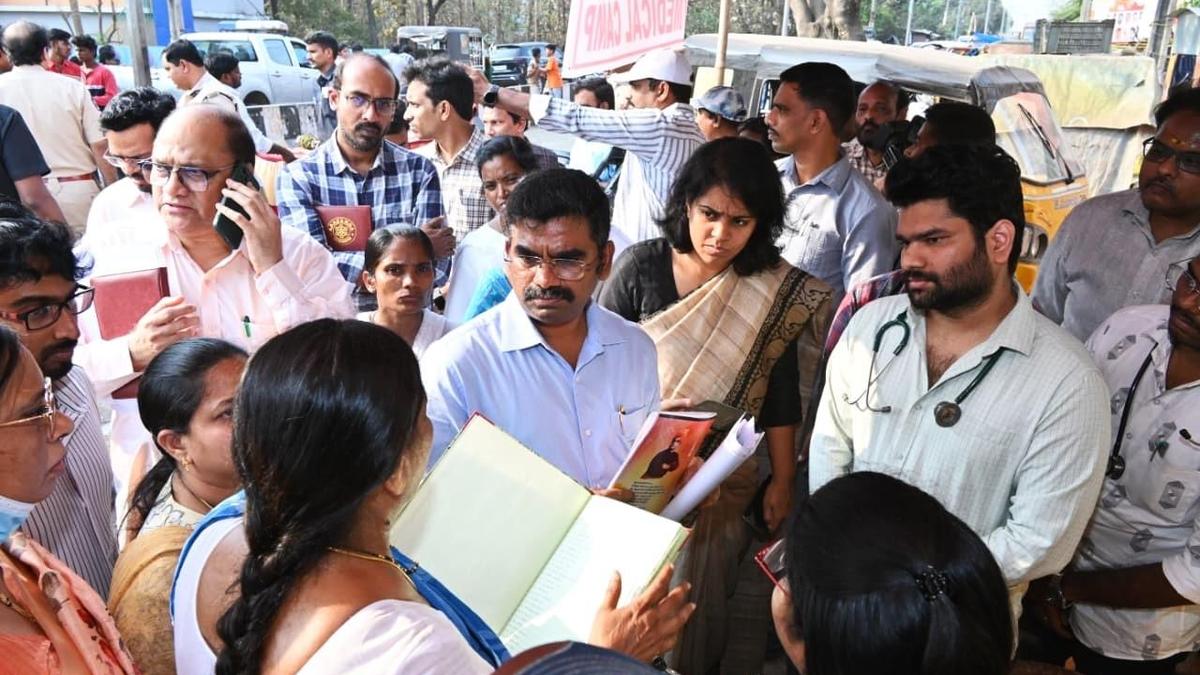
Family members of patients interacting with District Collector Kirthi Chekuri and SP D. Narasimha Kishore at a private hospital in Rajamahendravaram city.
As the day progressed and the toddler became engrossed in his play, his mother began to notice something odd. The child hadn’t urinated, which he normally did quite often throughout the day. By evening, she saw fatigue pooling thickly on his usually energetic face and felt an unease creeping into her heart. Soon, Rithik began to vomit everything he had consumed, even the glass of water that he had drunk earlier.
His panicked parents rushed him to a private hospital in the city on February 17, where doctors told them that both his kidneys had stopped functioning [acute renal failure and anuria (the cessation of urine output)] and that he needed immediate dialysis. They, however, couldn’t identify the exact cause. “Since his admission on February 18, doctors haven’t given us any assurance of his survival,” says Raju.
As of February 26, Rithik is on ventilator support, undergoing dialysis. Kirthi remains traumatised and inconsolable while a distraught Raju runs between pharmacy and the ICU door, haemorrhaging his life savings in the process.
Unbeknownst to Raju and Kirthi, the tragedy that befell their household is just the tip of a disaster unfolding in their city.
Adulterated milk
Thirty-three-year-old milk vendor Addala Ganeswararao has run Varalakshmi Dairy at Narsapuram village in East Godavari district for over a decade. He procured milk from 46 dairy farmers and packed it at his dairy unit before making a 20-km ride on his two-wheeler to deliver it to customers in Rajamahendravaram by 8 a.m. Between February 16 and 18, he supplied milk door-to-door to 106 families in the city; however, many of those who consumed this milk began experiencing anuria within hours, followed by hospitalisation for acute renal failure.
By February 24, five people had died, including six-year-old B. Manohar from Swaroopa Nagar, where many families had bought milk from Ganesh. The other deceased were Krishna Veni (76) and T. Ramani (58) from Gandhipuram, Radha Krishna Murthy (74) from Swaroopa Nagar and N. Seshagiri Rao (72) from Chowdeswari Nagar. Krishna Veni’s was the first death, on February 22; she had consumed the milk on February 16 and 17.
An elderly woman giving her blood for testing during a door-to-door check-up at Chowdeswaranagar in Rajamahendravaram | Photo Credit: T. APPALA NAIDU
“Fifteen people, including three children below the age of three, who [had] consumed milk supplied by the same vendor are on ventilator support and require dialysis as of February 26,” reads a health bulletin released by the Medical and Health Department.
On February 24, the State government announced free treatment for those affected by the milk contamination, offering some respite to families like Raju’s. The previous day, Chief Minister N. Chandrababu Naidu, during the State Assembly session, announced ₹10 lakh in ex gratia for the families of the deceased.
Notably, only the elderly and children below six years of age appear to have been severely affected. The youngest victim is five-month-old Mallareddy Ruhanya, whose family lives near the railway station.
“We began purchasing milk from Ganesh after Ruhanya turned five months old because her mother’s health didn’t permit breastfeeding,” says M. Teja, the child’s maternal uncle. Ruhanya, who was admitted to Rainbow Hospital on February 17, remains on ventilator support.
Seshagiri Rao, a retired Junior Assistant from the Water Resources Department, was among the first to fall ill. He had reportedly consumed milk supplied by Ganesh on February 16 and 17. “We learned about the link with the adulterated milk only after the government intervened,” says his son Promod Neela, a Hyderabad-based tech professional. Despite undergoing advanced treatment, including plasmapheresis, and multiple dialysis sessions, Seshagiri Rao passed away on February 23.
Plasmapheresis is an advanced blood filtration procedure that removes toxins and replaces plasma. It is one of the most sophisticated treatments available in the city, but costs approximately ₹1 lakh a day, including associated medical support.
G. Mallika, a 28-year-old software engineer residing at Laalacheruvu area and a customer of Ganesh, says she learned later that a neighbour had complained of unusual odour and discolouration in the milk two days prior to February 16, the day she gave her twin children Jaykrith Hemanshi and Jaykrith Raj, aged two years and nine months, a glass of milk each. “I served the milk myself, but didn’t detect any odour. I don’t consume milk, so I couldn’t judge its quality,” says Mallika. Raj began vomiting that night and was initially taken to Government General Hospital (GGH-Rajamahendravaram) and then to GGH-Kakinada for advanced treatment.
“On February 17, his serum creatinine level was 4.8 mg/dL. Within 48 hours, it rose to 7 mg/dL, indicating acute renal failure and necessitating immediate dialysis,” Mallika says. Within four days, Raj underwent five dialysis sessions, including three within 24 hours. Doctors have described his condition as critical; the child is currently in the ICU of Rainbow Hospital’s Mother and Child Care unit in Rajamahendravaram city.
Rapid Response team personnel conducting door-to-door survey to identify people affected by consuming adulterated milk in Chowdeswaranagar in Rajamahendravaram city. | Photo Credit: T. APPALA NAIDU
Creatinine levels are indicators of kidney function. A normal level is roughly 0.7 to 1.3 mg/dL and even lower for children. Elevated levels suggest impaired filtration. Notably, all patients, including those who died, reportedly had a history of anuria during initial medical examination.
Finding the link
Bandaru Karthik, a software engineer, began connecting the dots after his parents and aunt developed similar symptoms. “Doctors initially suspected food poisoning, but I retraced everything my parents had consumed before the onset of vomiting and anuria. At the hospital, we realised multiple patients had purchased milk from the same vendor,” he says.
On February 21, the authorities finally issued an alert, and on February 22, East Godavari District Collector Kirthi Chekuri deployed Rapid Response Teams and set up medical camps in Chowdeswari Nagar and Swaroopa Nagar. “Ganesh supplied milk to 106 families across the city. Five have died and 15 are under treatment as of February 26,” said the Collector. Preliminary investigations revealed that the dairy unit was operating without prescribed food safety protocols.
No substance identified yet
The exact contaminant remains unidentified as of February 26. Samples have been sent to multiple laboratories, including IIT-Tirupati, the Food Testing Laboratory at JNTU-Kakinada, VIMTA Labs in Hyderabad and the Veterinary Biological Research Institute in Vijayawada for toxicological analysis.
The authorities are also testing blood and urine samples for nephrotoxins, drawing parallels with chronic kidney ailments reported in Andhra Pradesh’s Uddanam region.
Arrest of vendor
On February 23, Ganesh was arrested by the Kovvur Divisional Police. He has been booked under BNS Section 103, which carries punishment of up to life imprisonment or death. He is currently remanded in judicial custody at the Rajahmundry Central Prison.
Published - February 27, 2026 10:18 am IST

