


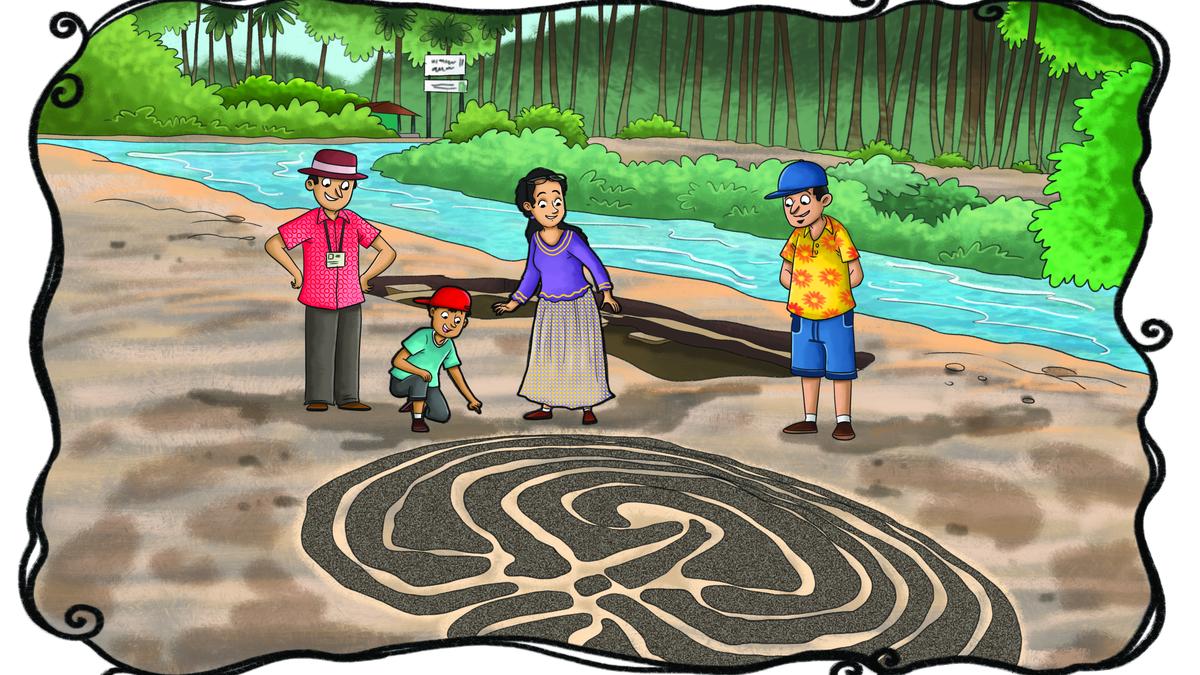
“What does this signify? It looks like a brain? A maze? An early man rangoli?” Taran stood on a rock at Usgalimal, Rivona, South Goa. His parents and he had arrived with a local guide on two scooters.
“Very strange! Maybe it was for a ritual?” Said Amma, taking off her sunglasses to get a better look.
The day had started like any other for a tourist in Goa. They had eaten breakfast and played in the waters of the Arabian Sea. But Taran had wanted to do something different. On enquiry, the hotel manager had informed them that a 30-minute ride would take them to this prehistoric wonder from the Neolithic Age.
“Let’s go!” Taran had pleaded. It had been a beautiful ride through picturesque villages, winding roads and scenic views of forests. They stopped by the banks of the Kushavati River, where they spotted the strange spiral on the rocks.
“Maybe there is no deeper meaning ... just a random piece of art ... somebody just felt like making a design ... some squiggles on stone”, mused Appa.
Taran and Amma smiled. “Well, we will never know now. Maybe it’s a path to a cave, but I feel this was a way to document their lives,” said Amma.
Their guide beckoned them to look at some of the other figures. These were more fathomable.
” An antelope? Or an ox perhaps? This is more straightforward,” said Taran.
Along with the guide, they tried to cover as much of the 500 sq.m. of the area, which had been recognised as an ancient archaeological site. A few other tourists, also looking for offbeat destinations in Goa, were walking .around
“This site was not known until around 1993! Some locals discovered it accidentally. There are more than 100 carved figures. It is good to see people making an effort to come and see these places,” said the guide, looking pleased.
“I remember from my textbooks that the Neolithic age was from about 7000 to 1000 BCE. Early man was becoming a settler and growing crops. That explains why they have been carved by a river. They must have lived here. Amma, do you think they imagined that someone would come all these years later to look at their carvings?”
Taran sat down to take this all in. That humans had walked on these same rocks thousands of years ago was something to think about. He placed his hand on the figure of a rock-cut man.
“You are not forgotten,” he whispered. He felt as if the man carved on the rock turned to smile at him.
Published - March 13, 2026 09:20 am IST

