Nepal elections 2026 highlights: Himalayan country votes to elect new PM, six months after Gen Z movement toppled Oli-led govt

Nepal’s Election Commission said its preliminary estimates suggest a 60% voter turnout in polls

Updated - March 05, 2026 08:58 pm IST

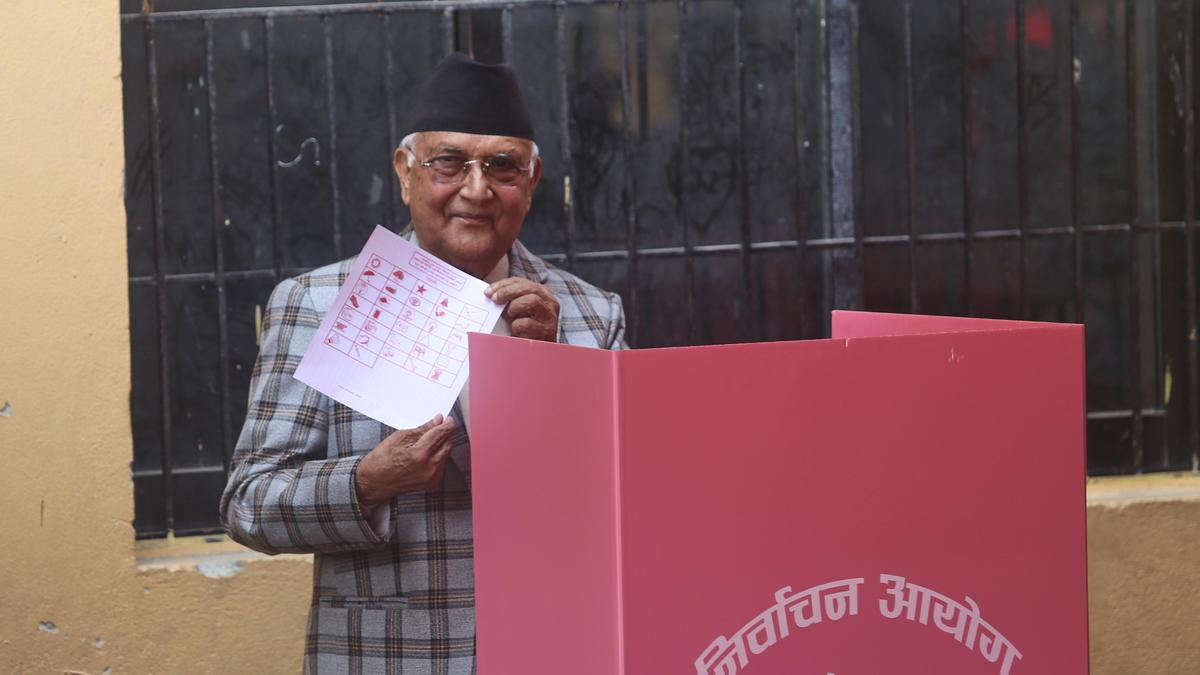
Khadga Prassad Oli, President of Communist Party of Nepal (Unified Marxist–Leninist) casts his vote at a polling station for the parliamentary election in Kathmandu, Nepal, Thursday, March 5, 2026.

Khadga Prassad Oli, President of Communist Party of Nepal (Unified Marxist–Leninist) casts his vote at a polling station for the parliamentary election in Kathmandu, Nepal, Thursday, March 5, 2026. | Photo Credit: AP

Tens of thousands of Nepalese voted on Thursday (March 5, 2026) in the crucial parliamentary elections to elect a new Prime Minister, six months after a violent Gen Z protest toppled the K.P. Sharma Oli-led coalition government. 

Also read: Nepal’s general election on March 5 seeks political change

Polling began at 7 a.m. across all 77 districts to elect a 275-member House of Representatives. The commission said polls concluded peacefully, barring some sporadic incidents in a few locations. 

The election is being held two years ahead of schedule because of the two-day Gen Z protests. The polls follow last September’s youth-led movement against corruption, misgovernance, and a patronage-driven economy long associated with an ageing political class.

Also read: Nepal goes to polls amid domestic upheaval and regional power plays

More than 18.9 million Nepalis were eligible to vote, with around 1 million added to the rolls since September’s youth protests, which claimed 77 lives, including 19 young people who were killed on the first day, September 8. 

This live is now closed.
Nepal polls: a defining moment with many ifs and more buts

Nepal polls: a defining moment with many ifs and more buts

Nepal's elections signal potential change amid uncertainty, with coalition dynamics and youth demands shaping the political landscape.

WATCH | Nepal Election 2026: Gen Z, protests & the generational fight for power

​​

​​

  • March 05, 2026 20:29
    Nepal awaits results in key post-uprising polls

    Nepal voted on Thursday for a new Parliament in a high-stakes showdown between an entrenched old guard and a powerful youth movement, six months after deadly anti-corruption protests toppled the government.

    Key figures contesting for power include the Marxist former Prime Minister seeking a return to office, a rapper-turned-mayor bidding for the youth vote, and the newly elected leader of the powerful Nepali Congress party.

    Election commission officials collected ballot boxes after voting closed, with papers taken under guard to centres before counting. 

    “The voting process has been concluded peacefully and enthusiastically,” Chief Election Commissioner Ram Prasad Bhandari told reporters, saying turnout had been around 60 percent according to initial estimates.

    Some winners are expected to be published as early as Friday, but full results may take several days.

    It may then take time before a government is formed if, as many analysts expect, no party wins an outright majority. 

    AFP

  • March 05, 2026 18:36
    Preliminary estimates suggest 60% voter turnout in polls

    Nepal’s Election Commission said its preliminary estimates suggest a 60% voter turnout in Thursday’s polls, the first since the Gen Z protests in September last year.

    “Our preliminary assessment is that around 60% of votes were cast,” said Acting Chief Election Commissioner Ram Prasad Bhandari during a press conference on Thursday evening, after polls closed at 5 p.m.

    Polling began at 7 a.m. across all 77 districts to elect a 275-member House of Representatives.

    The commission said polls concluded peacefully, barring some sporadic incidents in a few locations.

    More than 18.9 million Nepalis are eligible to vote, with around 1 million added to the rolls since September’s youth protests, which claimed 77 lives, including 19 young people who were killed on the first day, September 8.

    “We are still collecting details,” said Mr. Bhandari. 

    The 2013 Constituent Assembly elections recorded the highest turnout at 78.3%. The 2008 election to choose the first Constituent Assembly saw a turnout of 61.7%. In the two general elections held after the promulgation of the Constitution — in 2017 and 2022 — turnout stood at 68.7% and 61.4%, respectively.

    -Sandeep Satgainya

  • March 05, 2026 17:59
    Former PM Deuba conspicuous by his absence

    Former Prime Minister Sher Bahadur Deuba was conspicuous by his absence as Nepal voted in a crucial election triggered by last September’s protests.

    Mr. Deuba left for Singapore for “regular treatment” on February 25, with no clarity on whether he would return in time to cast his vote.

    The 79-year-old five-time Prime Minister was ousted as Nepali Congress president in January through the party’s special convention, which elected Gagan Thapa as the new party president.

    On the second day of the youth-led protests, September 9, Mr. Deuba, along with his wife Arzu Deuba, was manhandled by demonstrators at his home.

    After being denied a ticket this time, Mr. Deuba — who has won all seven elections he contested since 1990 from his home constituency of Dadeldhura-1 in the far-west — has avoided public appearances and did not participate in the Congress’s election campaign.

    Mr. Deuba has been a key figure in Nepal’s revolving-door politics since 1990.

    He won the last election in 2022 with 25,534 votes, beating his closest rival, an independent candidate, by a margin of 12,492 votes.

    This election could mark the end of Mr. Deuba’s 34-year political career.

    -Sanjeev Satgainya

  • March 05, 2026 17:27
    Voting closes; nearly 40% turnout recorded as of 3 p.m.

    Voting has officially closed in Nepal, as the Himalayan nation of 30 million people held its first election since the Gen Z protests in September last year, in which 77 people were killed. Those already in the queue, however, will be allowed to cast their votes, the Election Commission said.

    The Election Commission is yet to release the official voter turnout figures.

    Till 3 p.m., a turnout of nearly 40% had been recorded.

    There are over 18.9 million eligible voters, with around 1 million added to the rolls after the youth-led movement.

    The number of voters is up by 9,15,119 from the last elections held in 2022. Of them, 52% are aged between 18 and 40, whose votes are expected to be decisive.

    Voting began at 7 a.m. and closed at 5 p.m.

    -Sanjeev Satgainya

  • March 05, 2026 16:49
    Top contenders for PM post who couldn't vote for themselves

    Balendra Shah, a senior leader of the Rastriya Swatantra Party, was born and brought up in Kathmandu. But he decided to challenge Mr. Oli and contested from Jhapa-5. He, however, could not vote for himself, as he cast his ballot in Kathmandu-2.

    Nepali Congress’s newly elected president Gagan Thapa also voted from Kathmandu, while he is contesting from Sarlahi-4, a constituency in Madhesh bordering India. 

    The two, along with Mr. Oli, are widely viewed as the top contenders for the Prime Minister’s post.

    Pushpa Kamal Dahal, the coordinator of the Nepali Communist Party, a newly formed bloc of left-leaning parties, voted from Chitwan-3, though he is contesting from Rukum-1, a Maoist stronghold during the decade-long insurgency he led between 1996 and 2006.

    Rastriya Swatantra Party chief Rabi Lamichhane voted from Kathmandu-3 though he is running from Chitwan-2, where he has won twice — first in the November 2022 general election and then in a by-election in April 2023 after his Parliament membership was revoked over a citizenship issue. He contested the by-election after obtaining his citizenship.

    - Sanjeev Satgainya

  • March 05, 2026 16:47
    Why former PM Oli couldn't vote for himself

    K.P. Sharma Oli, the former Prime Minister and chairman of the Communist Party of Nepal (Unified Marxist-Leninist), is contesting from Jhapa-5 in the east. But since he is a registered voter in Bhaktapur, a district bordering Kathmandu, the capital, he cast his vote in Balkot.

    Nepal’s election law allows candidates to file their nominations from any of the 165 constituencies in the country’s 77 districts, but they can vote only where they are registered.

    - Sanjeev Satgainya

  • March 05, 2026 16:15
    40% voter turnout till 3 p.m. across Nepal

    A turnout of nearly 40% has been recorded in Nepal’s parliamentary elections till 3pm, since voting began at 7 a.m.

    According to the Election Commission of Nepal (ECN), around 7.41 million voters — approximately 40% of over 18.9 million eligible voters — had cast their votes by 3 p.m. all across the country.

    In the Kathmandu Valley, comprising the three districts of Kathmandu, Lalitpur, and Bhaktapur, turnout stood at 51%. Bagmati Province, which has 10 districts including those of the Kathmandu Valley, recorded 53% voter turnout.

    Turnout in Koshi Province (14 districts) in the east is 58%; in Madhesh (8 districts), 54%; in Gandaki (11 districts), 41%; in Lumbini (12 districts), 38%; in Karnali (10 districts), 42%; and in Sudurpashchim (9 districts), 43%.

    There are 77 districts in Nepal. The ECN has set up 23,112 polling centres at 10,963 polling stations across the country.

    - Sanjeev Satgainya

  • March 05, 2026 14:42
    Former PMs who aren't contesting the elections

    Sher Bahadur Deuba, a five-time Prime Minister, is not contesting this election.

    Mr. Deuba, 79, was ousted as Nepali Congress President in January through the party’s special convention, which elected Gagan Thapa as the new party president.

    On the second day of the youth-led protest, September 9, Mr. Deuba, along with his wife Arzu Deuba, was manhandled by demonstrators at his home.

    After being denied a ticket this time, Mr. Deuba, who has won all seven elections since 1990, has avoided public appearances and did not participate in the Congress election campaigning.

    He won the last election in 2022 from Dadeldhura-1 in the far-west with 25,534 votes, beating his closest rival, an independent candidate, by a margin of 12,492 votes.

    Another former Prime Minister, Baburam Bhattarai, a former Maoist leader, had filed his nomination from Gorkha-2 but later withdrew following a request from the Rastriya Swatantra Party.

    Mr. Bhattarai did not contest the 2022 elections.

    - Sanjeev Satgainya

  • March 05, 2026 14:40
    Former PMs in the fray | Madhav Kumar Nepal

    Another former Prime Minister in the fray is Madhav Kumar Nepal.

    Mr. Nepal is contesting from the same constituency, Rautahat-1 in Madhesh, from where he won the 2022 elections with 33,552 votes. He is contesting on the Nepali Communist Party ticket, a new leftist bloc that Mr. Dahal cobbled together after the Gen Z protests.

    There are 108,726 voters in the Rautahat-1 constituency, up 6.1% from the last elections.

    - Sanjeev Satgainya

  • March 05, 2026 14:36
    Former PMs in the fray | Pushpa Kamal Dahal

    Another former Prime Minister, Pushpa Kamal Dahal, cast his ballot in Chitwan-3. He has shifted to Rukum-1 this time in search of a safer constituency. Rukum used to be a stronghold of the 10-year Maoist insurgency that Mr. Dahal led.

    The 71-year-old three-time Prime Minister won the 2022 elections from Gorkha-2, securing 26,103 votes. There are 34,772 voters in the constituency, up 1.9% from the last elections.

    - Sanjeev Satgainya

  • March 05, 2026 14:22
    Former PM K.P. Oli votes in Nepal's high-stakes 2026 General Elections

    Former Prime Minister K.P. Sharma Oli cast his ballot on Thursday from Balkot in Bhaktapur, a district bordering Kathmandu, in an election triggered by a youth-led movement six months ago that overthrew his government.

    Mr. Oli, chairman of the Communist Party of Nepal (Unified Marxist-Leninist), is contesting from Jhapa-5, his home turf, where he won handily in 2022, securing 49,300 votes. There are 163,379 voters in the constituency, up 5.9% from the last elections.

    This time, the 71-year-old three-time Prime Minister is facing Rastriya Swatantra Party’s Balendra Shah, and analysts are expecting tough competition. Mr. Shah, a former Kathmandu mayor, is eyeing the national stage with this election.

    - Sanjeev Satgainya

    Bhaktapur [Nepal], Mar 05 (ANI): Former Prime Minister and Prime Ministerial Candidate of the Communist Party of Nepal (Unified Marxist–Leninist) (CPN-UML), KP Sharma Oli, casts his vote for Nepal's General Elections 2026 at a polling station, in Bhaktapur on Thursday. (ANI Video Grab)

    Photo credits: ANI

  • March 05, 2026 14:01
    25% voter turnout till 1 p.m.

    A turnout of nearly 25% has been recorded in Nepal’s parliamentary elections till 1 p.m., since voting began at 7 a.m.

    According to the Election Commission of Nepal (ECN), around 4.68 million voters — approximately 24.78% of over 18.9 million eligible voters — had cast their votes by 1 p.m.

    In the Kathmandu Valley, comprising the three districts of Kathmandu, Lalitpur, and Bhaktapur, turnout stood at 25.55%.

    Bagmati Province, which has 10 districts including those of the Kathmandu Valley, recorded 29.40% voter turnout.

    Turnout in Koshi Province (14 districts) in the east is 23.15%; in Madhesh (8 districts), 16.15%; in Gandaki (11 districts), 32.69%; in Lumbini (12 districts), 25.40%; in Karnali (10 districts), 24.38%; and in Sudurpashchim (9 districts), 29.66%.

    - Sanjeev Satgainya

  • March 05, 2026 13:16
    16% poll turnout till noon

    A turnout of a little over 16% was recorded till noon after polling began at 7 a.m. in a crucial election Nepal is holding six months after the Gen Z protests.

    According to the Election Commission of Nepal (ECN), 3.19 million voters — around 16.88% — had cast their votes till noon.

    There are more than 18.9 million eligible voters, with around 1 million added to the rolls since September’s youth protests, which toppled the K.P. Sharma Oli government and eventually triggered Thursday’s vote.

    The number of voters is up by 915,119 from the last elections held in 2022. Of them, 52% are aged between 18 and 40, whose votes are expected to be decisive.

    In the Kathmandu Valley, comprising the three districts of Kathmandu, Lalitpur, and Bhaktapur, turnout has been recorded at 25.55%, while Bagmati Province, which has 10 districts including those in the Kathmandu Valley, has recorded 17.21%.

    Turnout in Koshi Province (28 districts) in the east is 15.60%; in Madhesh (8 districts), 10.46%; in Gandaki (11 districts), 22.5%; in Lumbini (12 districts), 16.06%; in Karnali (20 districts), 20.23%; and in Sudurpashchim (9 districts), 20.07%.

    There are seven provinces and 77 districts in Nepal. 

    The ECN has set up 23,112 polling centres at 10,963 polling stations across the country.

    - Sanjeev Satgainya

  • March 05, 2026 12:36
    Youth’s participation in this election ‘unprecedented’: Nepali Congress PM candidate

    As voting for Nepal’s 2026 general election officially got underway on Thursday (March 5, 2026), Nepali Congress parliamentary candidate Sachin Timalsena expressed strong confidence in a victory, highlighting the successful conduct of the polls across the country.

    On the electoral process, Mr. Timalsena addressed initial public concerns regarding the fairness of the vote.

    “The participation of youth in this election has been unprecedented. That’s what I believe it will be. If the youth choose a certain party as their leader or as their representative, the chances are that party will get elected,” he added.

    - ANI

  • March 05, 2026 12:19
    Prime Ministerial Candidate of CPN-UML K.P. Sharma Oli casts his vote

    Former Prime Minister K.P. Sharma Oli cast his vote from Balkot in Bhaktapur, a district bordering Kathmandu.

    The 71-year-old, three-time Prime Minister has won all seven elections since 1990 except one in 2008.

    He won the last election from Jhapa-5, securing 49,300 votes and beating his closest rival by a margin of 34,312. This time, he is facing Rastriya Swatantra Party’s Balendra Shah, and analysts are expecting a tough competition.

    - Sanjeev Satgainya

  • March 05, 2026 12:01
    Former Maoist leader Dahal votes in Chitwan while contesting from Rukum

    Former Maoist leader Pushpa Kamal Dahal is contesting from the Rukum constituency but voted in the Chitwan-3 constituency, where his daughter and former Mayor Renu Dahal is in the fray.

    Another closely watched race is in the Chitwan-2 constituency, where Rastriya Swatantra Party chief Rabi Lamichhane is contesting. Lamichhane voted from the Kathmandu-3 constituency instead of his own constituency.

    - Sanjeev Satgainya

  • March 05, 2026 11:51
    Rastriya Swatantra Party's Balendra Shah and other prominent leaders cast their vote

    Rastriya Swatantra Party Prime Ministerial candidate Balendra Shah casted his vote in Kathmandu-2 on Thursday (March 5, 2026).

    Mr. Shah, however, is contesting from the Jhapa-5 constituency in the east against former Prime Minister K.P. Sharma Oli of the Communist Party of Nepal (Unified Marxist-Leninist). He is registered as a voter in Kathmandu. Like Mr. Shah, Mr. Oli is not a registered voter in his constituency, as he is registered in Bhaktapur, near Kathmandu.

    Nepali Congress president Gagan Thapa, who is contesting from Sarlahi-4, is also registered as a voter in Kathmandu.

    - Sanjeev Satgainya

  • March 05, 2026 11:28
    Nepal’s interim PM Sushila Karki casts her vote

    **EDS: THIRD PARTY IMAGE** In this image received on March 5, 2026, Nepal’s Interim Prime Minister Sushila Karki casts her vote in the Nepal general elections, in Kathmandu, Nepal. (Handout via PTI Photo) (PTI03_05_2026_000067B)

  • March 05, 2026 11:25
    Nepal records 6% turnout till 9:30 a.m.

    The Election Commission said about 6% of eligible voters had cast their ballots by 9:30 a.m.

    Voting is ongoing smoothly across the country with minor incidents in a very few places, Election Commissioner Sagun Shumsher Rana was quoted as saying by the Kathmandu Post.

    Nepal Police confirmed that apart from minor disagreements at a few locations, no serious problems had occurred.

    - PTI

  • March 05, 2026 10:05
    News Analysis | Old parties dig in, new ones offer change as Nepal heads to polls

    Old parties dig in, new ones offer change as Nepal heads to the polls

    Nepal's upcoming elections see old parties clashing with new contenders as voters seek change amidst political instability.

  • March 05, 2026 09:39
    Nepal deploys over 3 lakh security personnel for March 5 polls

    Nepal has put in place foolproof security arrangements for Thursday’s (March 5, 2026) election with the deployment of over 3 lakh security personnel under an integrated security plan in coordination with the Nepal Army, the Election Commission said on Wednesday (March 4, 2026).

    Acting Election Commissioner Ram Prasad Bhandari said all preparations for the election have been completed and urged voters to participate actively and enthusiastically in the democratic exercise.

    Read the full story below

    Nepal deploys over 3 lakh security personnel for March 5 polls

    Nepal deploys over 300,000 security personnel for the March 5 polls, ensuring safety and minimal invalid ballots through voter education.

  • March 05, 2026 09:05
    Nepal goes to polls amid domestic upheaval and regional power plays

    Nepal goes for elections amid domestric upheaval

    Nepal's March 5 election aims to restore democracy amid recent protests and regional geopolitical tensions.

  • March 05, 2026 08:46
    WATCH | Nepal votes in first election since Gen Z-led protests

  • March 05, 2026 08:45
    Nepal interim PM says elections crucial for ‘determining our future’

    Nepal’s interim leader Sushila Karki called for peaceful elections on Thursday (March 5, 2026), the first polls since deadly 2025 anti-corruption protests toppled the government.

    “Every vote is important in determining our future,” the 73-year-old former Chief Justice, who came out of retirement to lead the South Asian nation, said in a statement.

    “Thank you for your patience and understanding, for ensuring a peaceful election,” she added.

    - AFP

  • March 05, 2026 08:40
    Nepalese seek political change

    The polls follow last September’s youth-led movement against corruption, misgovernance, and a patronage-driven economy long associated with an ageing political class.

    The vote is viewed as a corrective measure — an opportunity to break Nepal’s cycle of revolving-door politics that has plagued the country for decades and to create conditions for implementing the demands of the youth movement.

    Those demands — accountability, clean governance and economic reform — resonate well beyond the youth protesters and across the broader population.

    Read the full story below

    Nepal’s general election on March 5 seeks political change

    Nepal's March 5 election aims for political change, following youth protests demanding accountability and reform after recent turmoil.

  • March 05, 2026 08:38
    Nepal goes to polls in first general election since government-toppling Gen Z protests last year

    Nepalese on Thursday morning (March 5, 2026) started to reach polling booths to cast their vote in crucial general elections, the first since a violent Gen Z-led protest that toppled the K. P. Sharma Oli-led government last year.

    More than 18.9 million eligible Nepalese will be exercising their franchise to elect the 275-member House of Representatives from among the 3,406 candidates vying for 165 seats under direct voting and 3,135 candidates vying for 110 seats through the proportional representation system.

    The voting started at 7 a.m. and will conclude at 5 p.m. The counting will start immediately after the ballot boxes are collected.

    - PTI

0 / 0
Sign in to unlock member-only benefits!
  • Access 10 free stories every month
  • Save stories to read later
  • Access to comment on every story
  • Sign-up/manage your newsletter subscriptions with a single click
  • Get notified by email for early access to discounts & offers on our products
Sign in

Comments

Comments have to be in English, and in full sentences. They cannot be abusive or personal. Please abide by our community guidelines for posting your comments.

We have migrated to a new commenting platform. If you are already a registered user of The Hindu and logged in, you may continue to engage with our articles. If you do not have an account please register and login to post comments. Users can access their older comments by logging into their accounts on Vuukle.