


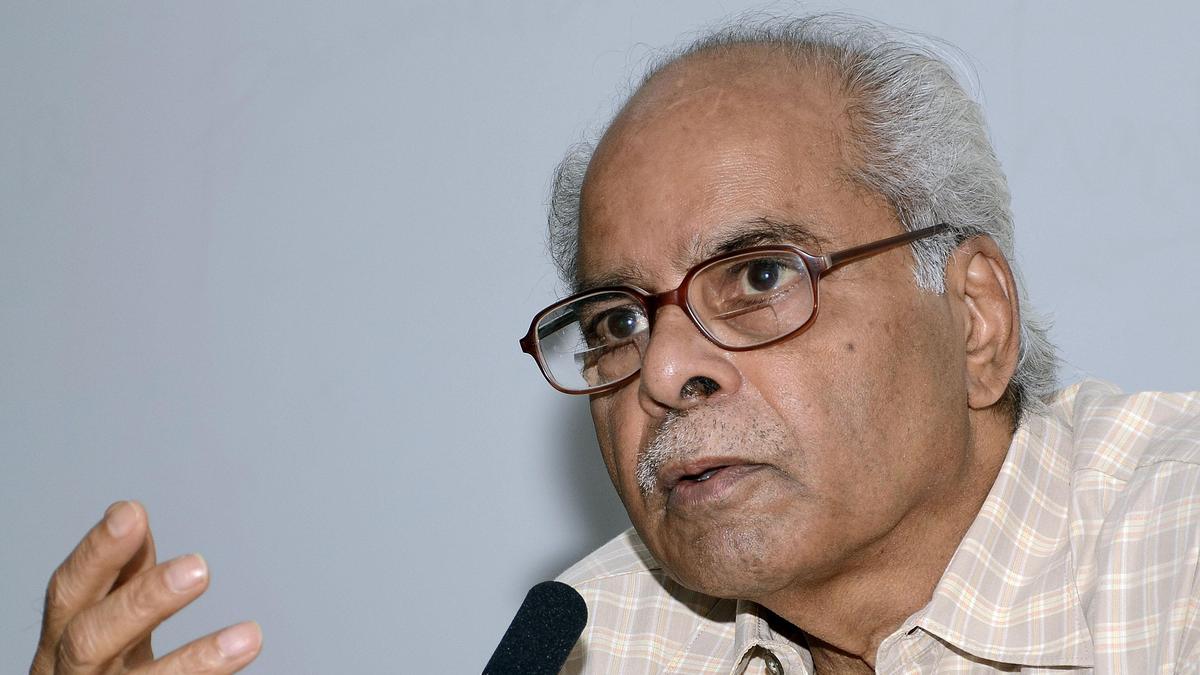
Eminent historian, academic and public intellectual K.N. Panikkar, widely regarded as one of India’s foremost scholars of modern history, passed away in Thiruvananthapuram on Monday (March 9, 2026). He was 89.
Professor Panikkar breathed his last at a private hospital in the State capital after age-related ailments.
Kandiyoor Narayana Panikkar, popularly known as K.N. Panikkar, was born to Krishnan Nair and Ichkutty Amma in Thaikkad near Guruvayur in 1936. He completed his schooling at Chavakkad Board High School.
He pursued his undergraduate studies at Government Victoria College in Palakkad, where he served as chairman of the college union. Prof. Panikkar later completed his postgraduate studies and PhD at the University of Rajasthan in Jaipur.
He had a distinguished academic career spanning several decades. After teaching in institutions including the University of Rajasthan, Hansraj College under the Delhi University, and the Indian Institute of Public Administration, he joined the Jawaharlal Nehru University (JNU) in 1972. At JNU, he served as Professor of History, Head of the Centre for Historical Studies, and later Dean of the School of Social Sciences. He had also served as visiting professor and fellow at several international universities.
Beyond teaching, Prof. Panikkar held important academic and institutional roles. He served as Vice-Chancellor of Sree Sankaracharya University of Sanskrit and later the first Vice-Chairperson of the Kerala State Higher Education Council. He was also the founding chairperson of the Kerala Council for Historical Research (KCHR).
Also read: Centralisation of education harmful to federal system: K.N. Panikkar
His death comes just as the KCHR was preparing to mark his 90th birthday (on April 26) with special programmes.
In 2008, he was elected president of the Indian History Congress, the country’s largest body of professional historians. He was also the founding president of the Kerala History Congress.
Prof. Panikkar authored numerous influential books and essays on colonialism, culture, religion, peasant movements and historiography.
His work on the Malabar region, colonial power structures and peasant uprisings remains widely cited in modern Indian historiography. The seminal work, Against Lord and State: Religion and Peasant Uprisings in Malabar (1836-1921), which examined the rebellion as a peasant uprising against landlordism and colonial power, had generated extensive scholarly debate and remains one of the most discussed interpretations of the event.
His other notable books include British Diplomacy in North India; Culture and Consciousness in Modern India; Culture, Ideology and Hegemony: Intellectuals and Social Consciousness in Colonial India; Communal Threat, Secular Challenge; Agenda for Cultural Action and Other Essays; Colonialism, Culture and Resistance; History as a Site of Struggle; and Caste in Kerala.
Aditya Mukherjee, who studied under Prof. Panikkar and later worked with him at the JNU from 1976 to 2000, said: “Professor Panikkar joined the JNU in 1972, the year the M.A. programme started in the university. He was handpicked as one of the first professors for the M.A. programme because he had developed a good reputation teaching at DU at the time. I was among the students in his first batch.”
Prof. Mukherjee later joined him as a professor at the Centre for Historical Studies, where Prof. Panikkar continued to mentor him. He remembers him as a “kind, soft-spoken and brilliant teacher”, adding, “Everyone who studied under him was impressed by his teaching. But apart from being a brilliant academic, he was also a fighter for progressive movements.”
G. Arunima, a professor at the JNU’s Centre for Women’s Studies and a student of Panikkar from 1984-1986, recalls him as gentle and sharp, and conversations with him as intellectually stimulating. Prof. Arunima said, “He did not mince his words when it came to things that mattered to him. Everyone would not necessarily agree with him, but all respected him. He cared deeply about higher education and remained very active even after retirement when he returned to Kerala.”
She added, “He also had a great sense of humour and was unfazed, because students could sometimes be difficult, but he would listen to them with a crinkle in his eye, and students would leave the conversation feeling good.” She said tributes from former students poured in on WhatsApp groups on Monday (March 9, 2026).
Prof. Panikkar’s wife, Usha Bhargava, had died earlier. He is survived by daughters Ragini and Shalini. The mortal remains of the deceased will be kept at his residence in Jawahar Nagar in Thiruvananthapuram for public homage from 10 a.m. till 4 p.m. on Tuesday (March 10, 2026). The cremation will be held later at Shantikavadam in Thycaud.
Published - March 09, 2026 04:11 pm IST

