


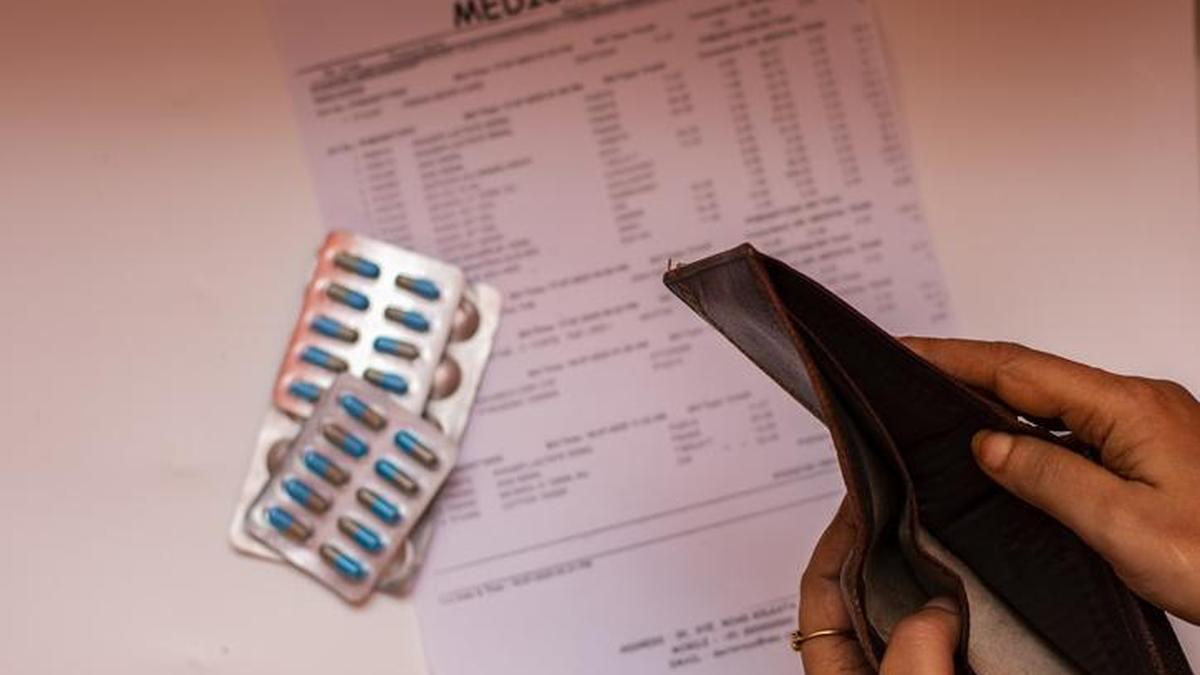
The most expensive disease just got a little more affordable to treat in India. Cancer treatment costs are three times higher than the hospitalisation expenditure for any average ailment in the country. Its medicines itself form the single largest component of expenditure in public hospitals — especially in rural areas.
Also Read | Inadequate diagnostic services still a critical gap in cancer care in India: NAMS report
The full exemption of basic customs duty proposed on 17 cancer-related drugs and medicines in the Budget, acts as a welcome balm for the stinging costs of life-saving care.
With India recording a 26.4% rise in cancer incidence between 1990 and 2023 — among the highest increases globally — the cost of treating the disease has become a severe burden. As the disease spreads, the financial strain on patients is deepening faster than the health system’s ability to absorb it.
As shown in the chart below, the average cost for a typical hospital stay was ₹20,135, while cancer patients spent over ₹61,000 per visit according to the 2017-18 National Sample Survey (NSS) on health.
When the data is disaggregated by facility type, a worrying trend emerges. While it is well-documented that private hospitals charge over four times more than public facilities for cancer treatment, the relative financial burden is actually higher in the government sector. In private hospitals, the average cost of cancer care (₹93,305) was roughly three times that of a typical hospitalisation (₹31,845) in 2017-18. In contrast, a cancer stay in a public hospital (₹22,520) costs about five times as much as a standard admission (₹4,452).
This higher ‘cost multiplier’ in the public sector suggests that cancer care places a disproportionately heavy strain on the resources of the poor. The financial strain is even more pronounced when the data is disaggregated by location. In rural public hospitals, the cost multiplier for cancer treatment climbs to 5.5x, compared to 4.1x in urban public facilities.
As shown in the chart below, this rural-urban disparity is far less significant in the private sector, where the relative cost burden remains more consistent regardless of location.
Widening gap
It is also significant that this gap in public hospitals was not nearly as wide, just a few years earlier, in 2014. According to the 2014 NSS on health, the average cost of cancer care in private hospitals (₹78,050) was roughly three times that of a typical hospitalisation (₹25,850).
This indicates that the cost multiplier for private hospitals remained consistent in the four years leading up to the latest 2017-18 data. In contrast, in 2014, a cancer stay in a public hospital (₹24,526) costs about four times as much as a standard admission (₹6,120). It is important to note that this cost multiplier for public hospitals has increased by a full point — climbing from 4 in 2014 to 5 in the 2017-18 figures.
A look at hospitalisation costs shows that medicines form the single largest component of medical expenditure across both public and private hospitals, in rural as well as urban India. This is especially true in public hospitals, where doctor and surgeon fees are negligible; here, spending on medicines accounts for approximately 40% to 50% of the total expense.
Even in private hospitals — where doctor fees and package costs are substantial — the share of expenditure on medicines still represents around 20% to 25% of the bill.
This trend highlights that medicines comprise a larger share of out-of-pocket cancer care costs for poorer patients in government hospitals, making the recent duty reduction a key intervention.
With inputs from Vignesh Radhakrishnan
Published - March 10, 2026 07:00 am IST

