


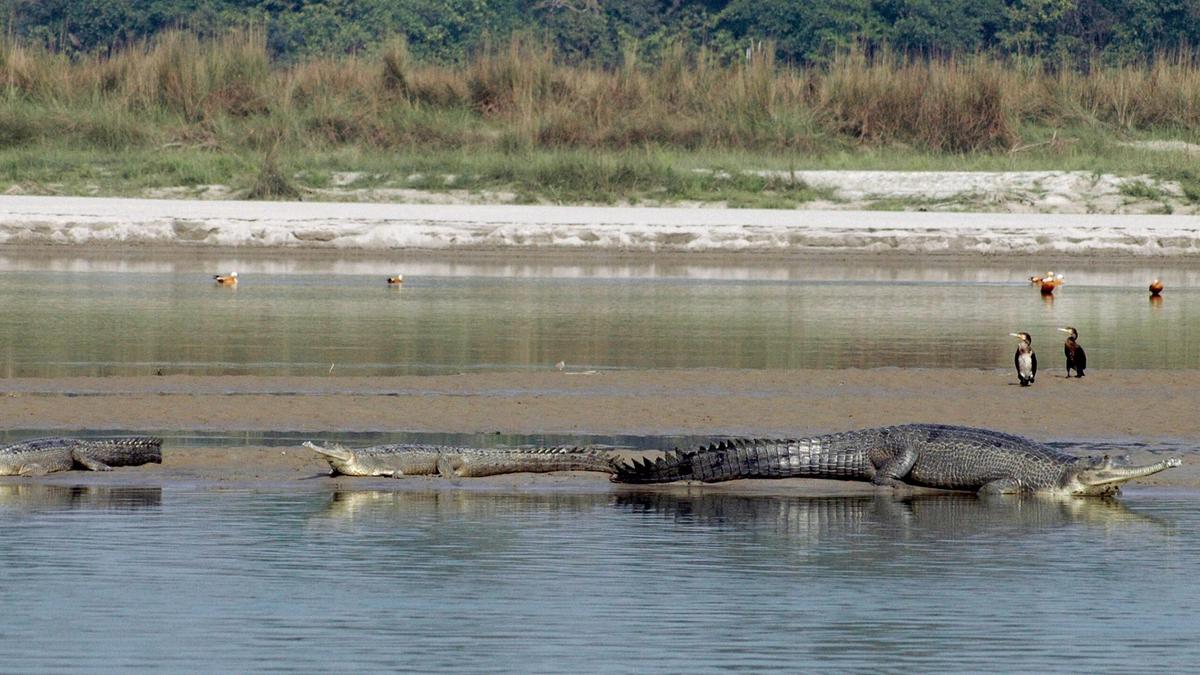
The Supreme Court on Friday (March 13, 2026) decided to step in to save the fragile lotic ecosystem of the National Chambal Sanctuary, home and breeding spot for the critically-endangered gharials or fish-eating crocodiles situated at the trijunction of Rajasthan, Madhya Pradesh and Uttar Pradesh, from rampant and illegal sand mining.
A Bench of Justices Vikram Nath and Sandeep Mehta took suo motu cognisance of media reports about the constant threat caused by sand mining to the ecology and aquatic life of the eco-sensitive zone.
The court said the situation had become so bad that the gharials were relocated from their habitats. But, eventually, even the area to which they had been shifted to by the Madhya Pradesh government had also been dug into by the sand mining mafia.
The problem had become so acute that the National Green Tribunal had taken cognisance of a report ‘Digging up the Chambal’ of The Hindu in March 2022 and ordered the authorities to periodically monitor and control illegal mining.
A comprehensive plan submitted for the conservation of the Chambal ecology in the NGT had alerted that “sand mining is the biggest threat to the sanctuary”.
The report submitted before the tribunal had said that the activity was not only degrading the critical habitat for sand nesting species, but also affecting the morphology of the river and its water-retaining properties.
It said the mining activity was well-planned, aggressive and the local enforcement authorities hardly posed a threat to the mafia.
“Most of the sand mining is carried out by organised sand mafias that confront in the form of severe aggression against the forest department. Tractor-trolleys are mainly involved in excavation of sand from the river bed and dumping it in their fields around the villages, from where it gets exported by trucks. The sand mafias use vehicles which do not have their registration number displayed. This prevents the forest department from capturing the true culprit. Lack of support from other law enforcing agencies further aggravates the issue,” the report had detailed.
The report said the terrain also inadvertently aids the mafia to operate throughout the year. Due to lack of rain and flood waters, the sand banks remain exposed throughout the year, which enables the mining mafia to function all year round. Further, low flows in the rest of the year, enables mining tractors from across the states to cross the river and access mining sites
The National Chambal Sanctuary is situated in a large arc of the Chambal River, covering nearly1800 km across Rajasthan, Madhya Pradesh and Uttar Pradesh. It is the first and only tri-state riverine protected area in India.
About 600 of the 960-km stretch of the Chambal River has been declared as the National Chambal Sanctuary by the three states in their respective territorial jurisdictions. The Chambal sanctuary in Madhya Pradesh was notified on December 20, 1978.
Besides Gharials, the sanctuary hosts a rich biodiversity of Marsh Crocodile Muggers, several species of freshwater turtles, including the endangered Red Crowned Roof Turtle, Smoothcoated Otters, Gangetic River Dolphins, Indian Skimmer, Black-bellied Tern, Sarus Crane and Black-necked Storks.
Published - March 13, 2026 12:19 pm IST

