


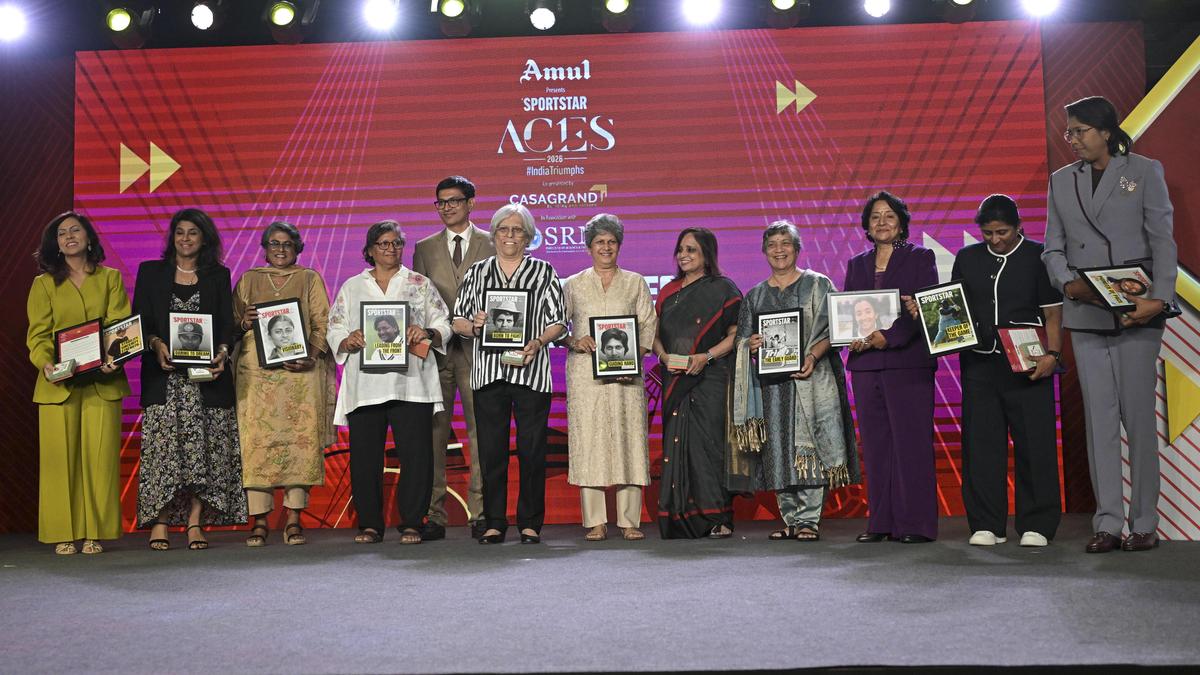
Ten former captains of the Indian women’s cricket team — Diana Edulji, Shubhangi Kulkarni, Sudha Shah, Nilima Joglekar, Sandhya Agarwal, Pramila Bhat, Purnima Rau, Chanderkanta Kaul, Anju Jain and Jhulan Goswami — were honoured with the Sportstar–Casagrand Standard Award at the Sportstar Aces Awards 2026, held at the Taj Mahal Palace in Mumbai on Friday, in recognition of their collective role in shaping the journey of the women’s game in India.
The award was presented by Nirmala Lakshman, Chairperson of The Hindu Group, and Sumanth Krishna, Director of Casagrand.
For those who played in those early years, passion often had to compensate for the absence of support.
“Fifty years is a long time. Our journey has been a long one, and it was very difficult playing in those days,” said former captain Diana Edulji.
“People would say women shouldn’t play and that they belonged in the kitchen. But we survived all that. We played purely for the passion. We even paid our own expenses to travel abroad and represent India. Today, it’s a completely different ball game.”
For decades, the team competed largely outside the national spotlight. That began to change in 2005 when India reached the Women’s World Cup final in South Africa, announcing itself on the global stage.
Structural shift
The subsequent integration of women’s cricket into the Board of Control for Cricket in India (BCCI) brought a significant structural shift, improving facilities, funding and administrative support.
Yet the moment that truly altered the sport’s trajectory arrived in 2017.
India’s run to the final of the 2017 ICC Women’s Cricket World Cup at Lord’s captured the imagination of a nation. It was the first Women’s World Cup in which every match was available either on television or via live streaming, and the final itself was played before a sold-out crowd.
For former captain Sudha Shah, the contrast with earlier decades could hardly be sharper.
“When we started playing cricket, spectators often came out of curiosity just to see whether women could actually play,” she recalled.
“None of our matches were televised, and we were lucky if we found a small corner in the newspaper. There was simply no visibility. Today, these cricketers are household names, and it’s wonderful to see.”
The rise of the modern Indian women’s team has been built on the foundation laid by those earlier generations.
For Jhulan Goswami, one of the greatest fast bowlers the game has produced, the journey began with inspiration drawn from the legends she watched growing up.
“When I started playing, I used to watch Kapil Dev, Glenn McGrath and Wasim Akram,” she said.
“Over the years I’ve understood that cricket is all about consistency and hard work. As a youngster, I just wanted to bowl fast. When I played with boys, they rarely gave me the ball because they thought I would bowl slow. That only pushed me to bowl even faster.”
The launch of the Women’s Premier League in 2023 further expanded the sport’s reach and commercial value.
That progress reached a historic peak in 2025 when India lifted its maiden ICC Women’s Cricket World Cup title.
World champs feted
The current Indian women’s team was also recognised with the National Team of the Year award for that landmark triumph.
The award was accepted by Deepti Sharma and Sneh Rana, alongside national team bowling coach Aavishkar Salvi, from former captains Shubhangi Kulkarni and Nilima Joglekar, in the presence of Parveen Chander Kumar (SVP – Taj Group of Hotels).
“We enjoyed the journey a lot,” Deepti said.
“Even after the first three games didn’t go our way, we didn’t get nervous. We kept believing that the deeper we went into the tournament, the closer we would get to having a real chance of winning.”
Sneh Rana emphasised the team’s preparation and belief.
“The belief within the group was very strong. We started planning everything almost six months in advance — working on strategies, practising constantly and backing ourselves,” she said.
“Even after losses, we never lost that belief. We even made a trophy and told ourselves that one day we would lift the real one. You could call it manifestation — and eventually, it happened.”
Published - March 14, 2026 12:41 am IST

