


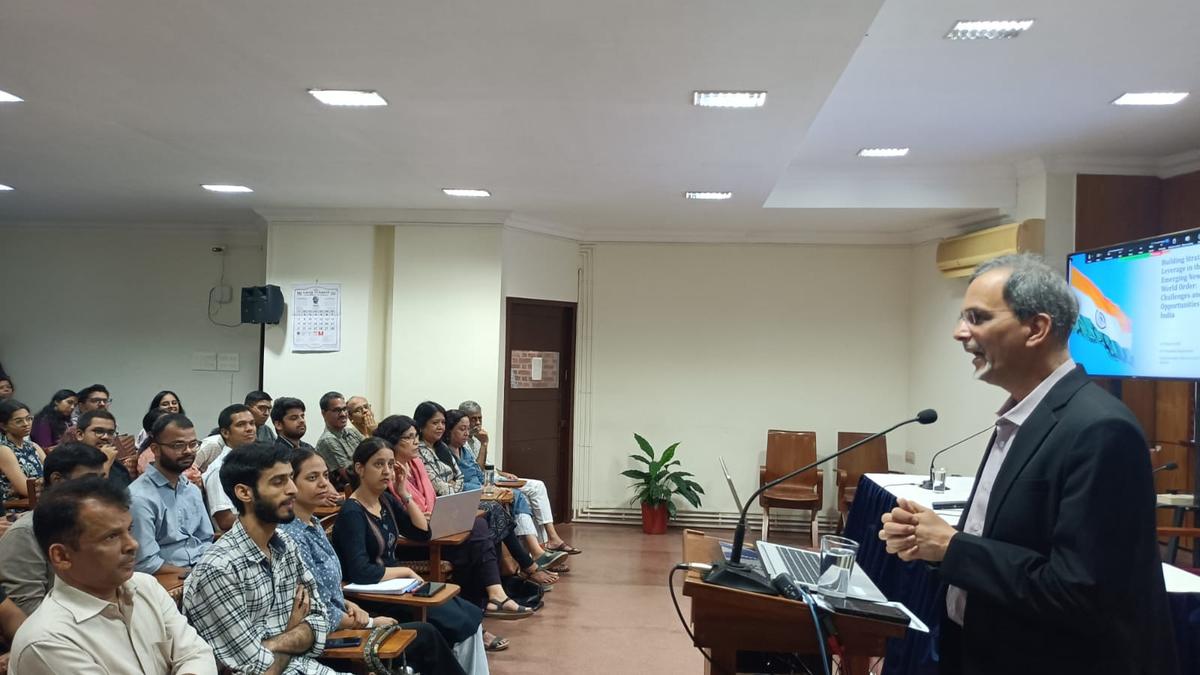
V. Anantha Nageswaran, Chief Economic Advisor to the Government of India, on Monday underscored the importance of ‘Swadeshi-first’ reforms, export competitiveness and a pragmatic approach to Net Zero targets in India’s efforts to build strategic resilience and competitiveness in the evolving geopolitical scenario.
Mr. Nageswaran was delivering the 13th P.K. Gopalakrishnan Memorial lecture on ‘Building strategic leverage in the emerging world order: Challenges and opportunities for India’ at the Centre for Development Studies (CDS) here. The ongoing conflict in the Persian Gulf, which is multidimensional in nature, has the capability to upset the strategic balance among nations for the next two or three decades, Mr. Nageswaran said.
“Earlier, whatever happens in the Persian Gulf, you would immediately think of it as an oil and gas problem, predominantly an oil price problem. But this one is multidimensional, and the kind of economic impact it will have on different nations including India will also upset or affect the strategic balance between nations. Everybody will be hurt for sure, but some may be hurt more than others and that will alter the strategic balance in the world for the next 20 to 30 years,” he said.
For building strategic resilience and strategic indispensability, competitiveness in manufacturing and export sectors matters, Mr. Nageswaran said. India’s growth story, he said, sits at the intersection of global headwinds and domestic potential. “Ultimately if we have to build strategic leverage and strategic indispensability, making stuff matters, making stuff well with high quality matters and therefore export-competitiveness matters. In doing so, Swadeshi matters,” he said.
On the policy front, Mr. Nageswaran called for ‘Swadeshi ecosystem-first reforms, a whole-of-government approach and cluster-led growth in the Indian scenario. He also underscored the need for world-class and reliable infrastructure and long-term policy stability and placing emphasis on the concept of an ‘entrepreneurial State.’ India may need to re-visit the ‘Swadeshi’ concept, hopefully with modifications. “It may have failed and we may have given it a go-by between 1990 and 2015 or 2020, but it may have to come back, hopefully with some modifications so that it doesn’t lead us to the same outcomes that we experienced earlier. Swadeshi matters and within it you have to indigenise,” he said.
As to why India should adopt this policy, he said that the nature of global systems has changed. It is now strategically competitive, and trade is no longer reciprocal -- it is one-sided, basically a big fish-small fish situation. Furthermore, markets are no longer neutral and supply chains have become instruments of State power.
Mr. Nageswaran also called for a pragmatic approach to Net Zero, arguing that oil and gas would continue to play dominant roles for longer than earlier thought. India should learn from Denmark’s realist turn and extract domestic hydrocarbon where available while building green capacity parallelly. India should avoid accepting Net Zero timelines designed around the energy structures and fiscal capacity of the Organisation for Economic Co-operation and Development (OECD) nations. The country should also avoid stranding fossil fuel assets prematurely, he said. CDS Director C. Veeramani chaired the session.
Published - March 16, 2026 07:06 pm IST

